
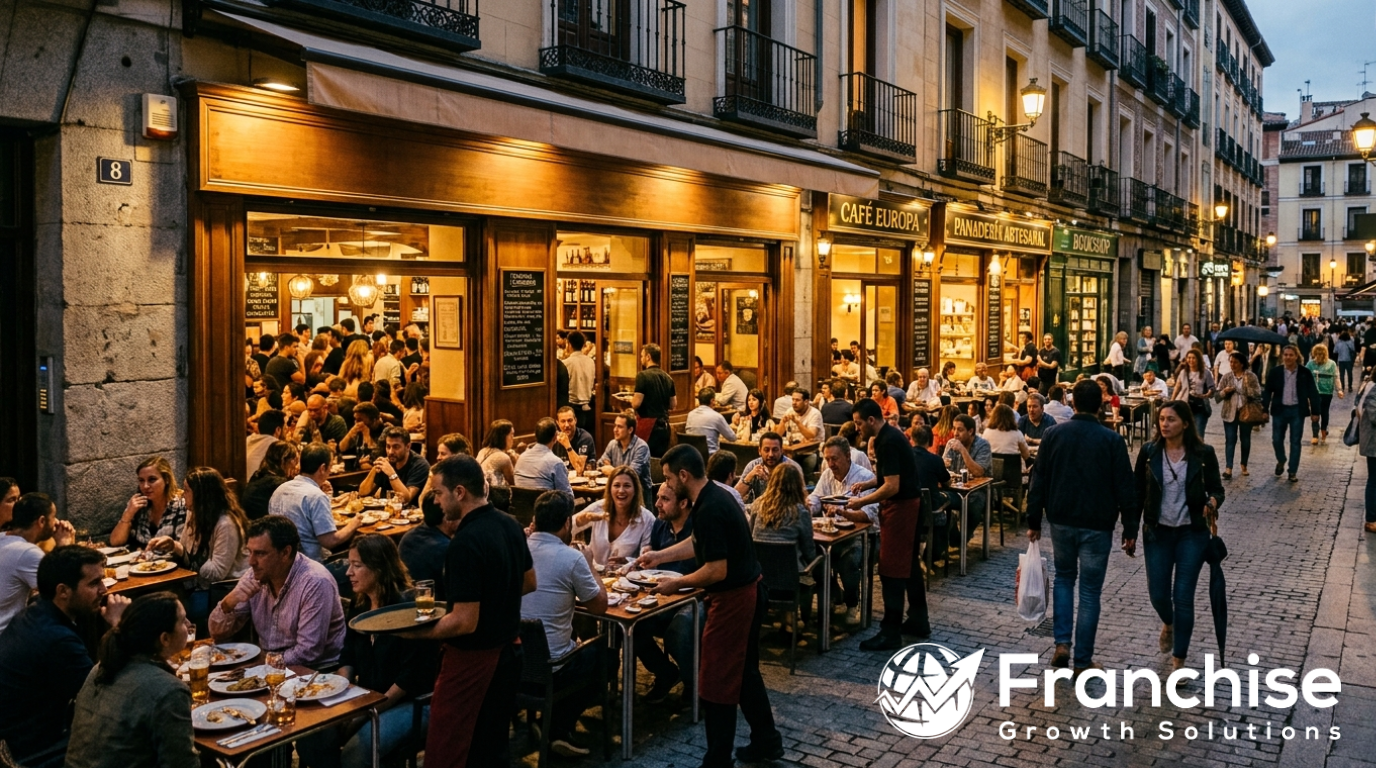
Photo Created by Canva
Successful restaurant site selection requires much more than strong demographics, high traffic counts, and affordable rent. This Executive Edition examines five critical components restaurant operators and franchisors should evaluate before approving a location: concept-to-market alignment, trade-area dynamics, accessibility and visibility, four-wall economics, and physical and operational feasibility.
RESTAURANT SITE SELECTION: THE FIVE CRITICAL COMPONENTS THAT DETERMINE RESTAURANT SUCCESS
Few decisions in the restaurant business carry as much long-term consequence as selecting the location. Menu items can be changed, pricing can be adjusted, employees can be retrained, marketing strategies can be replaced and operating procedures can be improved, but once a restaurant operator has signed a long-term lease, invested hundreds of thousands of dollars into construction and opened the doors, correcting a location mistake becomes extraordinarily difficult and potentially very expensive.
For this reason, I believe restaurant site selection should be viewed less as a traditional real-estate search and more as a sophisticated capital-allocation and underwriting decision. The objective is not simply to find an attractive storefront in a desirable community. The objective is to determine whether a particular restaurant concept, serving a particular customer, operating under a particular economic model, has a reasonable probability of generating sufficient demand and profitability at a particular physical location.
That distinction matters even more in today’s restaurant environment. In July 2026, the National Restaurant Association reported that although nominal restaurant and foodservice sales were expected to grow 4.3% during the year, inflation-adjusted sales were projected to increase only 0.8%, while customer traffic remained uneven. The Association also reported that food and labor each account for approximately 33 cents of every restaurant sales dollar and that 33% of surveyed operators said their restaurants were not profitable during the first half of 2026. These numbers do not mean restaurants cannot succeed, but they demonstrate how little room there can be for a major mistake in occupancy cost, construction expense or projected sales.
This is precisely why the traditional real-estate expression “location, location, location” does not adequately describe restaurant site selection. A better description might be concept, customer, economics and location, because a location cannot be evaluated intelligently without understanding the first three.
A busy intersection is not automatically a good restaurant site. An affluent ZIP code is not automatically a good restaurant market. A property with limited competition is not automatically an untapped opportunity, and a heavily traveled roadway is not necessarily valuable if customers cannot conveniently enter the property. Even inexpensive rent can become extremely expensive when the restaurant cannot generate sufficient sales from the location.
Academic research into franchise restaurant site selection reinforces the complexity of the decision. Research published in the Journal of Foodservice Business Research identified 56 individual site-selection factors organized into six major categories: general location, site position, demographics, traffic information, competition and cost considerations. Other restaurant-location research has likewise found that site characteristics, customer interaction, competition and appropriate selection of market variables matter when attempting to estimate the potential of a restaurant location.
Technology has substantially expanded what operators can analyze. Census information, geographic information systems, traffic information, consumer spending data, drive-time analysis and sophisticated location-intelligence platforms can provide information that previous generations of restaurateurs could never access easily. Yet more information does not automatically result in a better decision. ICSC recently cautioned that modern site-selection teams can become overwhelmed by backward-looking data and single-variable analysis, particularly when information concerning landlords, municipalities, future competition and changing market conditions is absent.
The objective, therefore, should not be to collect the greatest amount of information. It should be to identify the information that can answer the most important question: Can this restaurant concept generate sustainable economic performance from this particular location?
In my experience, that answer is largely determined by five interconnected components.
CONCEPT-TO-MARKET ALIGNMENT
The first component is market demand, but even that description can be misleading because population alone does not create demand. The real objective is determining whether there are enough consumers within the realistic trade area whose demographics, lifestyles, spending behavior, travel patterns and dining occasions align with what the restaurant is selling.
This is where restaurant operators sometimes make their first major site-selection mistake. They look for universally attractive demographics instead of demographics that are attractive specifically to their concept. A broker presents an area with strong population growth, a median household income of $125,000 and attractive household density, and the numbers immediately appear impressive. However, none of those statistics independently establish that the people living within the market have sufficient demand for the restaurant being considered.
Consider a breakfast and lunch café, a family-oriented pizza restaurant, an upscale steakhouse and a dessert concept. All four could examine exactly the same market and reach completely different conclusions because they serve different customers at different dayparts for different occasions and at different price points.
A lunch-oriented restaurant may require substantial employment density and daytime population in addition to residential population. A premium dinner concept may place greater emphasis on household income, discretionary spending, evening activity, destination traffic and nearby entertainment. A family-oriented restaurant may benefit from household composition, school-age children, residential stability, youth activities and weekend traffic. A coffee or breakfast concept may place much greater importance on commuter patterns and morning traffic direction.
The U.S. Census Bureau’s Census Business Builder illustrates how much market analysis has advanced beyond population counts. The platform provides demographic and economic information, geographic comparisons, business information and interactive mapping designed to help entrepreneurs understand markets when opening or expanding businesses. Census data can establish important facts about a market, but those facts still have to be interpreted through the economic and behavioral requirements of the concept.
This creates an important distinction between demographic attractiveness and concept compatibility. An affluent market may be attractive to many restaurant brands, but income alone cannot establish restaurant demand. A rapidly growing community can present tremendous opportunity, but growth may be dispersed across an enormous geographic area. A densely populated neighborhood can appear excellent on paper while transportation barriers, commuting patterns or cultural preferences materially affect the addressable customer base.
For franchisors, the best practice is to reverse the traditional real-estate process. Instead of finding an attractive property and subsequently attempting to prove the market works, the franchisor should establish the characteristics of successful markets from operating-unit data and then search for areas that reproduce those characteristics. That can include population density, household composition, income, employment, consumer spending, daypart demand, mobility patterns and other factors that have demonstrated predictive value for that specific concept.
The critical question is not whether the market looks good. The question is whether the market looks good for this restaurant.
THE TRADE AREA, DEMAND GENERATORS AND COMPETITIVE ENVIRONMENT
Once concept-to-market alignment has been established, the second component is understanding where customers will realistically originate and what will cause them to move through the restaurant’s commercial ecosystem.
For years, restaurant and retail site packages commonly presented one-mile, three-mile and five-mile demographic rings. Those measurements remain useful, but they can create a false sense of precision because customers do not travel in circles.
Five miles in a suburban market may be an easy ten-minute drive, while five miles in a densely populated metropolitan market can involve bridges, tolls, congestion or a thirty-minute trip. Rivers, highways, railroad tracks, mountains, limited-access roadways and street configurations can divide what appears to be a single geographic trade area into very different consumer markets.
Modern geographic tools therefore allow businesses to examine drive-time and travel-time areas rather than relying exclusively on fixed-radius measurements. Esri’s Business Analyst technology, for example, can generate trade areas based upon road networks, travel times, distance and historical traffic conditions. This does not eliminate the need for human judgment, but it provides a more realistic framework for estimating customer accessibility than simply drawing circles around an address.
Trade-area analysis should then examine the economic ecosystem surrounding the site. Major employers, schools, hospitals, supermarkets, entertainment destinations, shopping centers, fitness facilities, hotels, transportation hubs, residential developments and other businesses can become demand generators. Their importance varies dramatically according to restaurant category, which is another reason generic site-selection formulas can be dangerous.
Restaurant-location research has examined the concept of “people magnets,” meaning businesses or destinations that generate consumers who may also patronize nearby restaurants. Research involving executives responsible for major restaurant franchise locations found that restaurant categories differ in the types of nearby demand generators they prefer and that concepts often favor magnets offering benefits or customer occasions compatible with their own.
Competition must also be analyzed more intelligently than simply counting restaurants.
The absence of competition is not automatically positive, just as the presence of competitors is not automatically negative. A cluster of successful restaurants can indicate established dining demand, while an area with virtually no restaurant competition might represent an overlooked opportunity or could indicate that the market cannot economically support additional restaurant supply.
The distinction cannot be made from a competitor count alone.
Operators should investigate direct competitors, indirect competitors, price points, cuisine categories, hours of operation, customer reviews, apparent traffic levels, openings, closures and the overall restaurant ecosystem. A burger concept competes most directly with other burger restaurants, but it also competes for consumer occasions with pizza, sandwiches, chicken, tacos, convenience stores, supermarkets and virtually every other alternative available when the consumer decides where to spend a meal dollar.
For franchisors with existing restaurants nearby, this analysis must include another consideration: cannibalization. A proposed franchise location may produce substantial sales while simultaneously transferring customers from an existing franchisee. System sales may appear to increase even though the incremental economic value of the new location is substantially less impressive.
The appropriate question, therefore, is not simply how many competitors operate nearby. It is how much restaurant demand exists within the realistic trade area, what generates that demand, how much of it is already being captured and how much incremental demand can the proposed location reasonably capture.
TRAFFIC, VISIBILITY, ACCESS AND CUSTOMER FRICTION
Traffic counts are among the most frequently cited statistics in restaurant site selection and among the easiest to misuse.
The Federal Highway Administration defines Annual Average Daily Traffic, or AADT, as the average daily vehicle volume on a roadway over the course of a reporting year. Traffic volume is a legitimate and useful site-selection variable, but it describes how many vehicles use the roadway. It does not establish how many of those drivers are potential restaurant customers or how easily they can enter the property.
A site positioned along a roadway carrying 40,000 vehicles per day may initially appear superior to a site exposed to 20,000. However, the lower-traffic site can outperform if customers can see it earlier, enter more easily, exit safely, find parking immediately and return to their intended direction of travel without inconvenience.
This leads to what I consider one of the most important concepts in restaurant site selection: customer friction.
Every obstacle between awareness and purchase creates friction. A difficult left turn creates friction. A roadway median without convenient access creates friction. Poor signage creates friction. An entrance hidden behind another building creates friction. Insufficient parking creates friction. Confusing shopping-center circulation creates friction. For a drive-thru restaurant, inadequate stacking or a difficult escape lane creates friction. For a heavily digital restaurant, an inconvenient pickup area can create friction for both customers and delivery drivers.
Traffic should therefore be examined not merely by volume but by direction, velocity, daypart and accessibility. The Federal Highway Administration itself distinguishes average daily traffic from directional distribution and peak-hour measures, demonstrating why a single aggregate traffic number cannot describe all traffic conditions surrounding a property.
For example, a breakfast concept positioned on the inbound side of a commuter route may experience a fundamentally different opportunity than the identical concept positioned across a divided roadway. A dinner-driven restaurant might benefit from the reverse direction. The same traffic count can therefore have very different value depending upon which customers are traveling in which direction at which time of day.
Visibility remains important, but visibility should also be separated from accessibility. A restaurant can be exceptionally visible yet frustrating to enter. Another may have slightly less road exposure but offer effortless access, prominent signage and convenient parking. The second property may deliver the better customer experience before the customer ever walks through the door.
Technology has also changed the meaning of visibility because consumers increasingly discover restaurants through online search, mapping applications, social media, digital advertising and review platforms. This reduces some dependence on spontaneous visual discovery, particularly for destination-oriented restaurants, but technology cannot eliminate physical inconvenience after a customer decides to visit.
The correct question should therefore never be simply, “What is the traffic count?”
It should be: How much of this traffic is economically relevant to our restaurant, and how easily can we convert those people from passing traffic into paying customers?
FOUR-WALL ECONOMICS AND TOTAL OCCANCY EXPOSURE
A restaurant location cannot be considered successful unless the economics work.
This sounds obvious, but emotional attachment to a property frequently causes the analysis to move in the opposite direction. Operators become excited about a corner, shopping center or neighborhood and then attempt to justify the rent by constructing increasingly optimistic sales assumptions.
Professional underwriting should reverse that process.
Sales projections should determine what the restaurant can afford to pay for occupancy, rather than the asking rent determining the sales forecast needed to justify the site.
The National Restaurant Association’s 2025 Restaurant Operations Data Abstract provides useful context, but it also illustrates why industry statistics must be used carefully. Among more than 900 restaurant operators providing 2024 financial and operating information, median occupancy costs represented 5.7% of sales for full-service respondents and 5.2% for limited-service respondents. Those are valuable industry observations, but the Association specifically warns that its operating statistics should not be interpreted as universal standards or goals for individual restaurants.
That qualification is critical.
There is no scientifically established rule stating that every successful restaurant must keep occupancy below 6%, 8%, 10% or any other arbitrary percentage. A high-volume restaurant with strong margins may economically support a higher occupancy percentage than another concept with lower average unit volume or a more expensive labor model. Urban restaurants, suburban freestanding buildings, airports, food courts and shopping centers also operate under substantially different rent structures.
The correct occupancy threshold should therefore emerge from the concept’s own unit economics.
The analysis should include base rent, percentage rent where applicable, common-area maintenance charges, real-estate taxes, insurance obligations and other occupancy expenses. It should also consider expenses that are indirectly created by the property, including utility consumption, maintenance, security, trash removal, snow removal and location-specific wage requirements.
More importantly, rent should never be evaluated separately from total development cost.
A low-rent former retail location can become extraordinarily expensive if it requires new electrical service, grease-management systems, substantial plumbing, HVAC equipment, structural work or an entirely new restaurant exhaust system. Conversely, a higher-rent second-generation restaurant space with reusable infrastructure, an adequate hood system, sufficient utilities and a meaningful landlord contribution could represent the economically superior transaction.
The SBA specifically advises businesses evaluating locations to consider differences in rental rates, property values, salaries, minimum-wage laws, insurance, utilities, licenses, taxes and other location-specific expenses. The restaurant operator should therefore examine the entire economic burden of occupying the property, not merely the number printed beside “base rent” in the lease proposal.
Then the site should be stress-tested.
A restaurant-development model should evaluate at least a conservative case, an expected case and a strong-performance case. If a location works only when projected sales exceed the concept’s historical performance, construction comes in exactly on budget and the restaurant reaches maturity immediately after opening, the model may not be demonstrating opportunity. It may be demonstrating optimism.
Current industry economics reinforce the importance of this discipline. The National Restaurant Association reported in July 2026 that operating costs remain elevated and that food and labor continue to absorb roughly two-thirds of the typical restaurant sales dollar before occupancy, utilities, insurance, credit-card fees, repairs and other expenses are considered.
For a franchise system, there is an additional responsibility. Approving a location should not be based solely upon whether the franchisee can afford to build it. The question is whether the restaurant can reasonably generate an acceptable four-wall economic return after opening.
There is an enormous difference between a franchisee having enough capital to build a restaurant and the restaurant having the economic capacity to support the franchisee.
PHYSICAL, OPERATIONAL AND REGULATORY FEASIBILITY
The fifth component is the physical site itself, and this is where an otherwise attractive restaurant opportunity can encounter an expensive reality.
Restaurants are unusually infrastructure-intensive users of commercial space. Depending upon the concept, they may require substantial electrical capacity, natural gas, water, sewer capacity, grease-management infrastructure, ventilation, HVAC, refrigeration, fire suppression, floor drains, loading access, trash storage, customer parking, employee parking and specialized kitchen exhaust systems.
A vacant retail store is therefore not automatically a restaurant location.
Even a second-generation restaurant should not automatically be assumed to be suitable. A former café may have completely different electrical, exhaust, plumbing and grease requirements from a full-service restaurant. A small sandwich restaurant can operate with infrastructure that would be completely inadequate for a concept relying heavily upon fryers, grills, ovens and refrigeration.
Operational feasibility must also be considered. Where will food deliveries occur? Can delivery trucks reach the building without disrupting customers? Where will trash and used cooking oil be stored? Can employees move safely between the kitchen, storage and service areas? Is sufficient refrigeration possible? Can digital orders be staged without interfering with the dining room? Can third-party delivery drivers enter and exit efficiently?
For drive-thru restaurants, the analysis becomes even more demanding because stacking capacity, curb cuts, vehicle circulation, pedestrian conflicts, menu-board placement, order points and exit patterns can materially affect throughput.
The regulatory environment then becomes another component of physical feasibility. The SBA notes that business location determines applicable zoning laws, taxes, licenses, permits and regulations. Restaurant developers must therefore confirm that the intended use is permitted and determine whether restrictions involving signage, drive-thru operations, outdoor dining, alcohol, parking, grease disposal, hours of operation or other site-specific issues could materially affect the business.
These questions should be addressed during due diligence rather than after the lease becomes unconditional.
Restaurant operators sometimes treat architects, engineers and municipal reviews as activities that begin after securing the location. I believe the opposite mindset is safer. Critical physical and regulatory issues should be investigated early enough that discovering an unacceptable condition provides the operator with the ability to renegotiate the transaction or walk away.
A beautiful building that cannot economically accommodate the restaurant concept is not a great site. It is an expensive construction project with a restaurant attached to it.
THE FIVE COMPONENTS ARE NOT FIVE SEPARATE DECISIONS
The greatest mistake may be evaluating these five components independently because restaurant site selection is ultimately an interconnected economic system.
Strong demographics cannot compensate for fundamentally poor access. Extraordinary traffic counts cannot compensate for unsustainable occupancy costs. Cheap rent cannot create customer demand that does not exist. An excellent trade area cannot repair a building requiring an uneconomic construction budget, and an operationally perfect building cannot generate sufficient restaurant sales if the concept is fundamentally incompatible with the surrounding customer base.
This is why I believe sophisticated restaurant site selection should use both scoring criteria and disqualifying criteria.
A scoring model allows an organization to compare otherwise viable locations. Certain factors, however, should not merely reduce a score. They should stop the transaction. If the restaurant cannot achieve the required return under a reasonable sales assumption, the location should fail. If zoning cannot accommodate the intended operation, the location should fail unless there is a credible and acceptable path to approval. If access is fundamentally inconsistent with the consumer occasion, exceptional demographics should not automatically rescue the property.
This discipline also protects operators from confirmation bias. Once someone becomes emotionally invested in a location, there is a natural tendency to reinterpret unfavorable information as a problem that can somehow be overcome. Site-selection discipline requires exactly the opposite behavior. The closer an organization gets to signing the lease, the more aggressively it should search for reasons not to proceed.
Modern data can make that process substantially more sophisticated, but the technology should complement rather than replace firsthand market intelligence. Demographic platforms can measure population characteristics. Traffic systems can measure vehicle movement. Mapping technology can estimate drive times. Consumer databases can estimate purchasing behavior. None of those systems, by themselves, can tell the entire story of a property. Someone should still drive the market.
They should drive it during morning traffic, lunch, afternoon, dinner and weekends when relevant to the concept. They should watch how customers enter the shopping center, identify which restaurants are busy, examine parking behavior, speak with neighboring businesses, investigate planned development and understand what is happening at the municipal level.
The strongest site-selection conclusion emerges when quantitative data and physical market observation support one another.
THE QUESTION THAT SHOULD BE ASKED BEFORE EVERY RESTAURANT LEASE IS SIGNED
When evaluating restaurant real estate, asking whether a property is a “good site” is ultimately the wrong question.
The better question is whether this particular restaurant concept, serving this particular customer, from this particular property, within this particular trade area, under this particular cost structure, has a sufficiently strong probability of producing sustainable unit economics.
That is a much more difficult question to answer, but it is also the question that matters.
For an independent restaurateur, getting that answer wrong can threaten years of investment and personal capital. For a multi-unit organization, repeated site-selection mistakes can undermine the economics of an entire market.
For a franchisor, the consequences can be even greater.
A poorly performing franchise location affects more than one franchisee’s income statement. It can influence franchisee validation, resale values, lender confidence, future franchise sales, royalties, systemwide morale and the perceived strength of the brand. When multiple weak locations are approved in the pursuit of rapid development, the franchisor may eventually discover that it has succeeded in selling franchises while failing to build a durable franchise system.
Responsible restaurant expansion therefore requires a different objective.
The goal should not be to approve the greatest number of sites.
The goal should be to approve the greatest number of economically supportable sites.
That requires discipline, data, field investigation, realistic financial modeling and, perhaps most importantly, the willingness to reject a location after considerable time and effort have already been invested in evaluating it.
The discipline to say no to the wrong site may ultimately be as important as the ability to find the right one.
Because after all the demographic reports have been studied, the traffic counts analyzed, the lease negotiated, the architects retained and the construction completed, the customer will make the final determination.
And unlike the restaurant operator, the customer never signed the lease.
HOW FRANCHISE GROWTH SOLUTIONS APPROACHES RESTAURANT EXPANSION
At Franchise Growth Solutions, we believe restaurant development should begin with understanding the economics of the concept and identifying the market and site characteristics capable of reproducing those economics. Market analysis, territory development, real-estate evaluation and site approval should therefore operate as parts of a single expansion strategy rather than independent activities.
For emerging restaurant franchisors in particular, disciplined site selection can become one of the most important components of responsible franchising. Opening fewer restaurants in stronger locations can create substantially more enterprise value than accelerating development into markets and properties that have never been sufficiently underwritten.
We do not believe successful franchise development is about selling more franchises simply for the sake of selling more franchises.
It is about building better financial outcomes.
Copyright © 2026 Gary Occhiogrosso. All Rights Reserved Worldwide.
This publication is the intellectual property of Gary Occhiogrosso and is protected under United States and international copyright laws. No part of this publication may be reproduced, copied, distributed, transmitted, displayed, published, stored in a retrieval system, or translated into any language, in any form or by any means, including electronic, mechanical, photocopying, recording, scanning, or otherwise, without the prior written permission of the copyright owner, except for brief quotations used for review, commentary, criticism, or other uses permitted under applicable copyright law.
The information, opinions, observations, and recommendations contained in this publication are based upon the author’s professional experience, independent research, and analysis at the time of writing. They are provided for informational and educational purposes only and should not be construed as legal, financial, tax, accounting, investment, or other professional advice. Readers should consult qualified legal, financial, accounting, and other professional advisors before making business, investment, or franchise-related decisions.
References to franchisors, franchise systems, businesses, products, services, trademarks, or organizations are used solely for illustrative or educational purposes and do not constitute an endorsement, recommendation, or criticism unless expressly stated. All trademarks, service marks, and trade names remain the property of their respective owners.
While every reasonable effort has been made to ensure the accuracy of the information presented, the author makes no representations or warranties, express or implied, regarding the completeness, accuracy, or timeliness of the material and assumes no responsibility for errors, omissions, or changes that may occur after publication. Business conditions, laws, regulations, and market circumstances change over time, and readers are encouraged to conduct their own due diligence.
This publication reflects the opinions of the author and is intended to encourage thoughtful discussion regarding entrepreneurship, franchising, business ownership, and strategic growth. Any reliance upon the information contained herein is solely at the reader’s own risk.
For permissions, licensing inquiries, or reprint requests, please contact Franchise Growth Solutions at info@frangrow.com.
About the Author
Gary Occhiogrosso is the Founder and Managing Partner of Franchise Growth Solutions, a full-service franchise advisory and development firm dedicated to helping emerging and established brands grow responsibly through strategic planning, franchise development, operational excellence, and professional franchise sales. During a career spanning nearly four decades, Gary has worked with hundreds of franchise organizations and has participated in the development and sale of more than 1,000 franchise locations across a broad range of industries.
Recognized as one of the franchise industry’s leading authorities, Gary has been named among the Top 100 Franchise Influencers and the Top 25 Fast Casual Executives. His work focuses on helping entrepreneurs, founders, and franchisors build scalable businesses through disciplined growth strategies, sound unit economics, operational consistency, and responsible franchising.
Gary is a frequent speaker, author, and publisher whose Executive Edition articles are designed to help entrepreneurs make informed business decisions based on experience, research, and practical application rather than industry hype or conventional wisdom.
Author’s Transparency Statement
This article was researched, developed, written, and professionally edited with the assistance of advanced artificial intelligence (AI) tools. Throughout the development of this manuscript, AI served as a research assistant, editorial collaborator, and, where appropriate, a ghostwriting partner to help organize ideas, review publicly available information, improve clarity, strengthen the narrative, and enhance the overall quality of the writing.
The ideas, opinions, analysis, conclusions, and professional insights expressed throughout this article are those of the author and reflect decades of real-world experience in franchising, business development, and entrepreneurship. Every section was reviewed, refined, edited, and approved by the author to ensure it accurately reflects his knowledge, experience, perspective, and voice.
Artificial intelligence was used to support the creative and editorial process, not to replace the author’s expertise, judgment, or accountability. The author accepts full responsibility for the accuracy, integrity, and final content of this publication.
The author believes that the transparent and ethical use of artificial intelligence as a research assistant, editor, and ghostwriting tool can improve the quality, efficiency, and accessibility of professional business writing while preserving the author’s original ideas, experience, and intellectual ownership.
Author’s Note
This article also reflects the author’s professional observations and practical experience accumulated over nearly four decades advising entrepreneurs, franchisors, franchisees, and investors throughout North America. Practical experience has been combined with publicly available research to provide balanced commentary intended for educational purposes.
SOURCES
- National Restaurant Association. “Restaurants Remain Resilient Despite Challenging Business Conditions.” July 22, 2026.
Current analysis of restaurant sales, customer traffic, profitability and operating-cost pressures.
- National Restaurant Association. “Elevated Costs Continue to Pressure Restaurant Profitability.” July 8, 2026.
Analysis of restaurant food, labor and other operating costs and their impact on restaurant profitability and margins.
- National Restaurant Association. “Restaurant Occupancy Costs Were More Than 5% of Sales in 2024.” September 3, 2025.
Restaurant Operations Data Abstract findings covering median occupancy costs among full-service and limited-service restaurant respondents, including the Association’s qualification that these figures should not be treated as universal operating standards.
- U.S. Census Bureau. “Census Business Builder.”
Demographic, socioeconomic, geographic and economic information useful for evaluating prospective markets, customers, competitors and business locations.
URL:
https://www.census.gov/data/data-tools/cbb.html
- U.S. Census Bureau. “Powerful Data for Your Small Business.”
Census resources for researching customers, competitors, population characteristics, income, employment, household composition, market conditions and potential business locations.
URL:
https://www.census.gov/topics/business-economy/small-business/about/powerful-data.html
- Federal Highway Administration, U.S. Department of Transportation. “Traffic Monitoring Guide.”
Federal guidance concerning traffic-volume measurement, Annual Average Daily Traffic, directional traffic patterns, traffic monitoring methodology and other roadway-use data relevant to location analysis.
URL:
https://www.fhwa.dot.gov/policyinformation/tmguide/tmg_2022/
Additional FHWA traffic-monitoring reference:
https://www.fhwa.dot.gov/policyinformation/tmguide/tmg_2013/traffic-monitoring-theory.cfm
- U.S. Small Business Administration. “Pick Your Business Location.”
Guidance addressing zoning, regulations, rental rates, property values, utilities, wages, insurance, licensing, taxes and other location-specific considerations affecting business feasibility.
URL:
https://www.sba.gov/business-guide/launch-your-business/pick-your-business-location
- Park, Kunsoon and Mahmood A. Khan. “An Exploratory Study to Identify the Site Selection Factors for U.S. Franchise Restaurants.” Journal of Foodservice Business Research, Vol. 8, No. 1, pp. 97-114.
Academic research identifying six major categories and 56 individual factors associated with franchise restaurant site selection, including general location, site position, demographics, traffic, competition and cost considerations.
URL:
https://www.tandfonline.com/doi/abs/10.1300/J369v08n01_07
DOI:
https://doi.org/10.1300/J369v08n01_07
- Schaefer, Allen D., Robert H. Luke and Jerry Green. “Attitudes of Restaurant Site Selection Executives Toward Various People Magnets.” Journal of Restaurant & Foodservice Marketing, Vol. 1, Nos. 3-4, pp. 1-14.
Research examining how restaurant site-selection executives evaluate nearby traffic generators and how different restaurant categories can place different values on surrounding demand generators.
URL:
https://www.tandfonline.com/doi/abs/10.1300/J061v01n03_01
DOI:
https://doi.org/10.1300/J061v01n03_01
- Esri. “Generate Standard Geography, Distance, or Time-Based Trade Areas,” ArcGIS Business Analyst Documentation.
Technical documentation explaining the use of road networks, drive times, travel distances and geographic boundaries to develop trade areas and analyze potential markets.
Additional Esri Business Analyst trade-area documentation:
https://doc.esri.com/en/arcgis-pro/latest/tool-reference/business-analyst/an-overview-of-the-trade-areas-toolset.html
- ICSC. “The Confidence Crisis: Why More Data Hasn’t Made Retail Site Selection Easier.” January 5, 2026.
Industry analysis examining the limitations of relying exclusively on historical location data and advocating multi-scenario analysis, downside-risk assessment, qualitative market intelligence and the integration of human judgment with location technology.