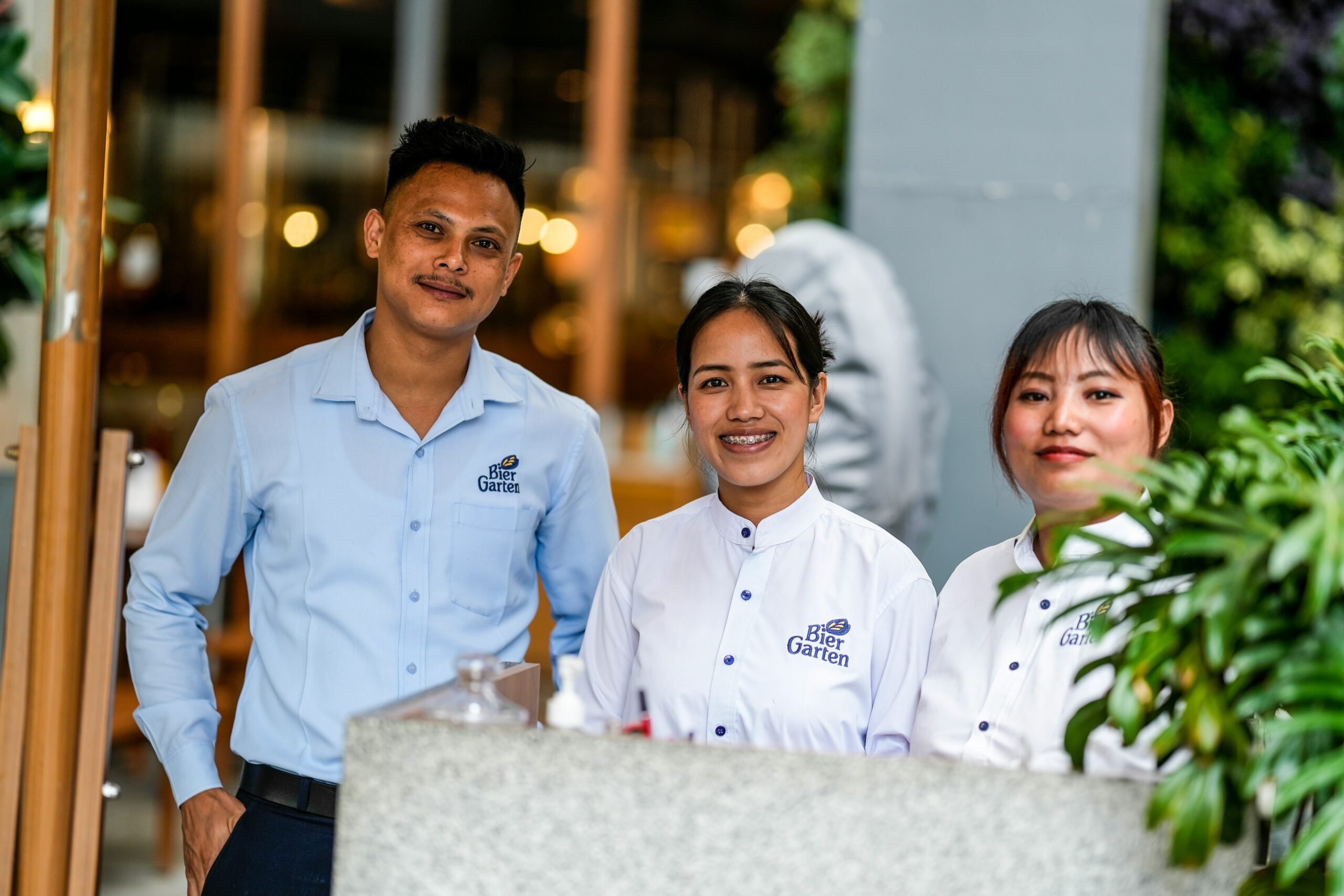
Photo by Lens Fables on Unsplash
Employee appreciation events and team-building activities can strengthen workplace relationships, but meaningful improvements in restaurant performance require more than an enjoyable afternoon together. For restaurant owners and franchise organizations, the greatest opportunity lies in connecting employee engagement, leadership development and everyday operating practices to the long-term success of the business.
BUILDING A STRONGER RESTAURANT TEAM REQUIRES MORE THAN A COMPANY PICNIC
By the Franchise Growth Solutions Think Team
A restaurant can have experienced kitchen staff, personable servers, competent managers, and an excellent product, yet still struggle to deliver the consistent customer experience its owners expect. The difficulty is not always attributable to inadequate training or a lack of individual talent. Frequently, it develops from the inability of otherwise capable employees to communicate effectively, coordinate their responsibilities and respond collectively when ordinary operating conditions become unusually demanding.
Consider what happens during an unexpectedly busy Friday evening. The dining room fills more quickly than anticipated, online orders begin arriving in greater volume, and an employee calls out at the last minute. While the kitchen attempts to keep pace with production, the front-of-house staff must manage guest expectations, address service delays, and maintain the atmosphere customers associate with the restaurant. Everyone may be working diligently, but unless employees understand how their responsibilities intersect and how to support one another, even a relatively minor disruption can compromise the entire guest experience.
These situations illustrate why building an effective restaurant team involves considerably more than assembling capable individuals and expecting them to perform well together. The relationships between employees, the quality of their communication and their confidence in management influence how the business functions when circumstances become difficult. They also help determine whether the organization can maintain its standards as additional employees, managers and locations are introduced.
For years, businesses have attempted to strengthen these relationships through company picnics, employee appreciation luncheons, recreational competitions and other team-building activities. Such gatherings can provide employees with welcome opportunities to relax, develop friendships and interact with coworkers outside their normal responsibilities. However, while these experiences have legitimate value, their ability to produce lasting operational improvements depends largely on what management does before and after the event.
For restaurant owners and franchise executives, the central question is not whether team-building activities are worthwhile, but how these activities can become part of a broader management strategy that develops better employees, stronger leaders and a more dependable operating organization.
The Business Case for Developing Stronger Teams
Employee engagement has become an important subject in management research, particularly as businesses examine the relationship between workplace conditions, employee retention and operating performance. Although engagement is sometimes discussed primarily in terms of employee satisfaction, its business implications extend to the quality of supervision, clarity of expectations, opportunities for professional development and the degree to which employees feel connected to their organization’s objectives.
Gallup’s 2024 Q12 meta-analysis examined research covering more than 3.3 million employees across approximately 184,000 business and work units. The analysis identified meaningful relationships between employee engagement and a variety of organizational outcomes, including productivity, profitability, employee turnover, and customer loyalty. Among its findings was a median 23% difference in profitability between business units in the highest and lowest engagement quartiles, underscoring the commercial importance of workplace conditions while requiring careful interpretation.
It would be incorrect to conclude that employee engagement alone accounts for the difference in profitability or that introducing recreational team-building activities can produce similar financial results. Engagement reflects multiple influences, including management effectiveness, compensation practices, employee expectations and organizational conditions. Nevertheless, the research provides a compelling reason for business owners to examine whether they are creating an environment in which employees understand their responsibilities, believe their contributions matter and have the support necessary to perform effectively.
Research examining teamwork interventions offers a more focused perspective. A 2017 systematic review published in PLOS ONE evaluated 51 studies involving 8,439 participants and found positive effects from structured teamwork interventions on both team behaviors and performance. Earlier findings were less consistent, including a 1999 meta-analysis that did not identify a statistically significant overall performance improvement attributable to team building, while a subsequent analysis published in 2009 found generally positive effects, particularly in areas involving team relationships and work processes.
The differences between these findings are important be
cause they caution against treating all team-building activities as equally effective. Structured exercises that help employees understand responsibilities, practice communication, and address operational problems serve a different purpose from recreational gatherings intended primarily to encourage social interaction. Both can contribute to a positive workplace, but their benefits should be evaluated according to what they were designed to accomplish rather than an assumption that every enjoyable activity will improve business performance.
For restaurants, these considerations are particularly relevant because the consequences of ineffective teamwork are often visible almost immediately. Miscommunication can lead to incorrect orders, service delays, dissatisfied guests, and avoidable operational complications. At the same time, poor supervisory practices may contribute to frustration among employees who otherwise have the ability and willingness to perform well. As the National Restaurant Association’s workforce research has emphasized, successful hiring, onboarding, and management practices remain important considerations in the financial performance of restaurant businesses.
The implication for owners is that improving workplace relationships should be viewed as part of the organization’s operating strategy rather than a discretionary activity undertaken only when time and financial resources permit.
Why Employee Appreciation and Social Activities Still Matter
The emphasis on operational results should not obscure a more fundamental consideration: employees appreciate being recognized for their efforts, particularly in businesses where the work can be physically demanding, unpredictable, and emotionally exhausting. Restaurant employees spend much of their working lives satisfying the needs of others, often during evenings, weekends, and holidays when friends and family members are enjoying leisure time. Providing an occasion for employees to relax and enjoy one another’s company can be a meaningful expression of appreciation, even when no specific productivity improvement is anticipated.
Company picnics remain popular for precisely this reason. A relaxed outdoor gathering creates opportunities for employees to spend time with coworkers they may know only through hurried conversations during their shifts. Members of the morning preparation team can become better acquainted with evening employees. At the same time, individuals from different departments or restaurant locations may discover common interests and develop personal relationships that would be difficult to establish during ordinary operating hours.
The same objective can be accomplished through an employee appreciation luncheon, a barbecue, an informal restaurant gathering, or a catered event. For organizations with limited budgets, the quality of the experience depends less on the expense of the occasion than on thoughtful planning and management’s genuine interest in recognizing the people responsible for the company’s daily performance. Providing an enjoyable meal, creating an atmosphere that encourages conversation, and allowing employees sufficient time to participate can accomplish more than an elaborate program that feels overly organized or obligatory.
Catering can be particularly helpful when coordinating larger gatherings because it allows managers to concentrate on their employees rather than the logistics of food preparation and service. Depending on the size and nature of the event, individually packaged lunches, sandwich selections, buffet service or prepared hot meals can provide practical solutions. Consideration should also be given to dietary preferences, food allergies, accessibility and the needs of employees whose schedules may prevent them from attending a single gathering.
Recreational activities can complement these occasions by reflecting the personalities and interests of the participating employees. Trivia competitions, collaborative puzzles, informal games, and creative challenges can encourage employees to interact with colleagues outside their usual social circles. At the same time, outdoor sports and similar activities may appeal to organizations whose employees enjoy friendly competition. Management should recognize, however, that participation will not be equally appealing or accessible to everyone, making it important to provide alternatives that allow employees with different interests and physical abilities to feel included.
For restaurant organizations, cooking competitions offer another possibility that combines entertainment with an activity employees already understand. Small groups can be challenged to develop a dish using a limited selection of ingredients, organize its preparation and present the finished product for friendly judging. The resulting interaction may reveal different approaches to problem-solving, organization, and cooperation. However, managers should avoid interpreting success in a recreational competition as definitive evidence of an employee’s professional capabilities.
These experiences are valuable primarily because they provide opportunities for connection, enjoyment and recognition. Their worth should not be diminished by demanding that every social event produce a measurable financial return, but neither should management assume that an enjoyable afternoon will resolve concerns that stem from inadequate staffing, inconsistent supervision, or unclear operating responsibilities.
Turning Team-Building Activities Into Practical Management Tools
The greatest opportunity for meaningful operational improvement arises when team development activities address the circumstances employees are likely to encounter in the ordinary course of business. Rather than relying exclusively on recreational exercises, restaurant owners can introduce short, carefully structured activities that encourage employees to work through real-world problems and develop a better understanding of how their individual responsibilities affect the overall performance of the operation.
A restaurant manager might, for example, present employees with a hypothetical situation involving an unexpected increase in customer traffic combined with an employee absence. Participants could be divided into small groups and asked to determine how responsibilities should be redistributed, which tasks require immediate attention, and how information should be communicated among the kitchen, service staff, and management. Once each group has presented its recommendations, the manager can lead a discussion to examine the different approaches and identify procedures that should be clarified or reinforced.
The exercise does not require elaborate preparation or an entire afternoon away from operations. In many circumstances, a brief workshop conducted during an appropriate training period may be sufficient to expose misunderstandings that would otherwise become apparent only during a difficult shift. An equally useful discussion might focus on handling an incorrect order, responding to a dissatisfied guest, managing unexpected delivery delays, or coordinating responsibilities when a large catering order arrives during a busy service period.
What distinguishes these activities from ordinary games is their direct relationship to the employees’ responsibilities. Participants are encouraged to consider how decisions made in one department affect coworkers elsewhere in the operation. At the same time, managers can observe communication patterns and identify areas where additional training may be needed. The discussion may also reveal that employees have developed informal solutions to recurring problems that management has never considered incorporating into its operating procedures.
This approach can produce another potential benefit by exposing management to employees who demonstrate leadership characteristics outside their normal assignments. An individual who rarely assumes a prominent role during daily operations may display patience, organizational ability, or sound judgment when asked to help colleagues solve a problem. Such observations can provide a useful starting point for identifying employees who might benefit from additional training or greater responsibility. However, actual supervisory readiness must be established through experience, consistent performance and demonstrated knowledge of the business.
Successful restaurant leadership involves far more than an ability to organize a group or communicate persuasively. Managers must understand operating costs, food safety, labor scheduling, customer service, employee supervision and the systems that govern the restaurant’s daily activities. Team-building exercises can help identify potential leadership talent. Still, they should complement rather than replace the formal development necessary to prepare employees for management responsibilities.
The more enduring benefit arises when lessons from an exercise influence subsequent management decisions. If employees discover that no one clearly understands who should communicate service delays to customers, the organization has identified a specific procedural weakness. Addressing that weakness through clarification, training, and ongoing supervision yields tangible results that extend beyond the activity itself.
Why Team Development Becomes More Complicated as a Franchise Brand Expands
The importance of communication and organizational consistency increases as a restaurant business expands beyond its original location. In a single restaurant, an owner may have personal relationships with nearly every employee and remain directly involved in resolving daily operating problems. As additional locations are developed, however, responsibilities become distributed among managers and operating teams who may have limited contact with the founder or with employees working elsewhere in the organization.
Growth introduces new challenges involving communication, leadership development, and the preservation of operating standards. Procedures that were once communicated informally must be documented and taught consistently. At the same time, managers need the ability to make appropriate decisions without requiring constant intervention from senior leadership. A business that has not developed these organizational capabilities may discover that opening additional locations introduces inconsistencies that become increasingly difficult to correct.
Franchising adds another dimension because the system generally comprises independently owned and operated businesses that operate under a common brand and framework. Franchisees typically manage their own employment relationships and local teams. At the same time, the franchisor provides the brand standards, training programs, and operational support contemplated by the franchise agreement. Recognizing these distinct responsibilities is essential when designing programs intended to encourage collaboration throughout a franchise network.
Franchisors can create opportunities for franchisees and their management representatives to exchange ideas through regional meetings, operational workshops, advisory gatherings and training conferences. These interactions can help participants better understand common challenges and learn from approaches that other operators have found useful. A franchisee who has developed an effective onboarding process, for example, may offer insights that other operators can evaluate. At the same time, another may have practical experience with managing catering volume, improving guest service or addressing scheduling difficulties.
Such exchanges should be approached thoughtfully because a practice that performs well in one location may not necessarily produce the same result elsewhere. Differences in market conditions, customer demographics, operating costs and management capabilities can influence outcomes, making it important for franchisors to evaluate proposed practices before incorporating them into broader recommendations or system standards.
The greater opportunity is to establish an organization in which knowledge can move efficiently between locations without compromising the operational consistency customers expect from a franchise brand. Franchisee collaboration, management training, and structured communication can help achieve this objective while supporting the development of a network better prepared to accommodate continued expansion.
For emerging franchisors, the lesson is particularly significant. Rapid expansion may be an attractive goal, but the ability to award franchise agreements and open additional restaurants must be supported by an organization capable of training, communicating with, and supporting the people responsible for operating those locations. Team development is therefore connected not only to employee morale but also to the management infrastructure required for responsible franchise growth.
Measuring Results Without Losing Sight of the Human Element
Businesses are accustomed to evaluating investments according to their financial consequences, and employee development initiatives are no exception. Nevertheless, the appropriate method of evaluation depends on the intended purpose of the activity. A company picnic organized to express appreciation should be judged primarily on whether employees felt welcome, enjoyed the occasion, and believed their contributions were recognized, while a workshop intended to improve operational communication deserves a more specific assessment of the behaviors management sought to change.
If employees participate in an exercise involving order accuracy, management can examine whether the resulting discussions reveal opportunities to improve procedures and whether those changes are subsequently implemented. An initiative intended to strengthen communication between shifts might be evaluated through employee feedback, management observations, and a review of recurring handoff problems. Leadership development activities can be followed by additional training assignments and assessments of employees’ performance when entrusted with greater responsibilities.
Broader performance indicators, including employee retention, guest complaints, customer satisfaction and operating consistency, may provide additional information over time. However, these measures are influenced by many variables, including compensation, staffing levels, scheduling, local economic conditions and the quality of management. A change in any one indicator following a team-building event should not automatically be attributed to the event itself.
A disciplined approach begins by identifying the business problem, selecting an activity that could reasonably help address it, and determining how management will evaluate what employees learned. Equally important is the willingness to follow through when the activity exposes an organizational weakness. Employees who raise legitimate concerns during a workshop but see no subsequent management response may reasonably question whether the company was interested in improving conditions or merely conducting an exercise.
Business owners should also recognize that employee appreciation programs entail responsibilities regarding accessibility, safety, and, in some circumstances, compensation. Under the federal Fair Labor Standards Act, attendance at meetings and training activities may generally be excluded from compensable working time only when all four relevant conditions are satisfied: the activity occurs outside normal working hours, attendance is voluntary, the activity is not job-related, and no productive work is performed. Applicable state and local requirements may impose additional obligations. At the same time, federal disability guidance recognizes that employer-sponsored social functions may be among the employment benefits for which reasonable accommodations are required.
These considerations are especially relevant in restaurants, where employees frequently work different shifts and may have family responsibilities or additional employment commitments. Thoughtful scheduling, appropriate participation arrangements, and reasonable accommodations should be incorporated into event planning rather than treated as secondary concerns. An organization that claims to value its employees should demonstrate that commitment through the practical decisions surrounding the event as well as the activity itself.
Conclusion: The Strongest Teams Are Developed Through Everyday Leadership
As restaurant businesses and franchise organizations prepare for continued growth, their ability to attract, retain, and develop capable employees will remain an important management consideration. Changes in consumer demand, labor availability, technology and operating costs will continue to place pressure on restaurant performance, increasing the importance of organizations whose employees can adapt to unexpected circumstances while maintaining established standards.
Team-building activities can make a worthwhile contribution to that objective, particularly when management understands the different purposes they serve. Social gatherings and catered employee appreciation events create opportunities for recognition and personal connection. At the same time, collaborative exercises can encourage communication, problem-solving and a greater understanding of shared responsibilities. Leadership development programs, operational training and franchisee collaboration can extend those benefits into the systems and management practices that support daily business performance.
None of these activities can compensate for consistently poor management, inadequate training or workplace conditions that employees find unreasonable. Their effectiveness ultimately depends on the broader environment in which they occur and on the willingness of business owners to reinforce the principles they promote through their everyday decisions.
For a restaurant owner preparing to expand, this distinction deserves careful consideration. Financial resources, attractive locations, effective marketing and strong consumer demand can create growth opportunities. Still, the ability to operate successfully across multiple locations also depends on developing people who understand the business and can work together to achieve consistent results. In a franchise organization, where operating responsibilities are distributed among independent owners and their management teams, that capability becomes an increasingly important component of the system’s long-term development.
A well-organized company picnic can create lasting memories, and an enjoyable team-building event can strengthen relationships among coworkers. The greater accomplishment is developing an organization in which those relationships translate into dependable communication, capable leadership and consistent execution long after the event has ended.
Franchise Growth Solutions works with emerging franchisors, established franchise systems and successful business owners seeking to develop the infrastructure, operational strategies and management practices necessary to support responsible franchise expansion. To learn more about franchising your business or strengthening an existing franchise organization, visit www.frangrow.com or contact info@frangrow.com.
© 2026 Franchise Growth Solutions, LLC. All Rights Reserved, Worldwide.
Sources and Research References
- National Restaurant Association. Workforce Staffing: How the Right Hiring Practices Drive ROI. April 23, 2026.
- https://restaurant.org/education-and-resources/resource-library/workforce-staffing-how-the-right-hiring-practices-drive-roi/
- Gallup. The Relationship Between Engagement at Work and Organizational Outcomes: Q12 Meta-Analysis, 11th Edition. 2024.
- https://www.gallup.com/workplace/321725/gallup-q12-meta-analysis.aspx
- McEwan, D., Ruissen, G. R., Eys, M. A., Zumbo, B. D., and Beauchamp, M. R. The Effectiveness of Teamwork Training on Teamwork Behaviors and Team Performance: A Systematic Review and Meta-Analysis of Controlled Interventions. PLOS ONE, 2017.
- https://doi.org/10.1371/journal.pone.0169604
- Salas, E., Rozell, D., Mullen, B., and Driskell, J. E. The Effect of Team Building on Performance: An Integration. Small Group Research, 1999.
- https://doi.org/10.1177/104649649903000303
- Klein, C., DiazGranados, D., Salas, E., and colleagues. Does Team Building Work? Small Group Research, 2009.
- https://doi.org/10.1177/1046496408328821
- U.S. Department of Labor. Fact Sheet #22: Hours Worked Under the Fair Labor Standards Act.
- https://www.dol.gov/agencies/whd/fact-sheets/22-flsa-hours-worked
- U.S. Equal Employment Opportunity Commission. Enforcement Guidance on Reasonable Accommodation and Undue Hardship Under the ADA.
- https://www.eeoc.gov/laws/guidance/enforcement-guidance-reasonable-accommodation-and-undue-hardship-under-ada
Copyright © Franchise Growth Solutions, LLC. All Rights Reserved Worldwide.
This publication is the intellectual property of Franchise Growth Solutions, LLC and is protected under United States and international copyright laws. No part of this publication may be reproduced, copied, distributed, transmitted, displayed, published, stored in a retrieval system, or translated into any language, in any form or by any means, including electronic, mechanical, photocopying, recording, scanning, or otherwise, without the prior written permission of the copyright owner, except for brief quotations used for review, commentary, criticism, or other uses permitted under applicable copyright law.
The information, opinions, observations, and recommendations contained in this publication are based upon the author’s professional experience, independent research, and analysis at the time of writing. They are provided for informational and educational purposes only and should not be construed as legal, financial, tax, accounting, investment, or other professional advice. Readers should consult qualified legal, financial, accounting, and other professional advisors before making business, investment, or franchise-related decisions.
References to franchisors, franchise systems, businesses, products, services, trademarks, or organizations are used solely for illustrative or educational purposes and do not constitute an endorsement, recommendation, or criticism unless expressly stated. All trademarks, service marks, and trade names remain the property of their respective owners.
While every reasonable effort has been made to ensure the accuracy of the information presented, the author makes no representations or warranties, express or implied, regarding the completeness, accuracy, or timeliness of the material and assumes no responsibility for errors, omissions, or changes that may occur after publication. Business conditions, laws, regulations, and market circumstances change over time, and readers are encouraged to conduct their own due diligence.
This publication reflects the opinions of the author and is intended to encourage thoughtful discussion regarding entrepreneurship, franchising, business ownership, and strategic growth. Any reliance upon the information contained herein is solely at the reader’s own risk.
For permissions, licensing inquiries, or reprint requests, please contact Franchise Growth Solutions at info@frangrow.com.
About Gary Occhiogrosso, Managing Parther
Gary Occhiogrosso is the Founder and Managing Partner of Franchise Growth Solutions, a full-service franchise advisory and development firm dedicated to helping emerging and established brands grow responsibly through strategic planning, franchise development, operational excellence, and professional franchise sales. During a career spanning nearly four decades, Gary has worked with hundreds of franchise organizations and has participated in the development and sale of more than 1,000 franchise locations across a broad range of industries.
Recognized as one of the franchise industry’s leading authorities, Gary has been named among the Top 100 Franchise Influencers and the Top 25 Fast Casual Executives. His work focuses on helping entrepreneurs, founders, and franchisors build scalable businesses through disciplined growth strategies, sound unit economics, operational consistency, and responsible franchising.
Gary is a frequent speaker, author, and publisher whose Executive Edition articles are designed to help entrepreneurs make informed business decisions based on experience, research, and practical application rather than industry hype or conventional wisdom.
Author’s Transparency Statement
This article was researched, developed, written, and professionally edited with the assistance of advanced artificial intelligence (AI) tools. Throughout the development of this manuscript, AI served as a research assistant, editorial collaborator, and, where appropriate, a ghostwriting partner to help organize ideas, review publicly available information, improve clarity, strengthen the narrative, and enhance the overall quality of the writing.
The ideas, opinions, analysis, conclusions, and professional insights expressed throughout this article are those of the author and reflect decades of real-world experience in franchising, business development, and entrepreneurship. Every section was reviewed, refined, edited, and approved by the author to ensure it accurately reflects his knowledge, experience, perspective, and voice.
Artificial intelligence was used to support the creative and editorial process, not to replace the author’s expertise, judgment, or accountability. The author accepts full responsibility for the accuracy, integrity, and final content of this publication.
The author believes that the transparent and ethical use of artificial intelligence as a research assistant, editor, and ghostwriting tool can improve the quality, efficiency, and accessibility of professional business writing while preserving the author’s original ideas, experience, and intellectual ownership.
Author’s Note
This article also reflects the author’s professional observations and practical experience accumulated over nearly four decades advising entrepreneurs, franchisors, franchisees, and investors throughout North America. Practical experience has been combined with publicly available research to provide balanced commentary intended for educational purposes.