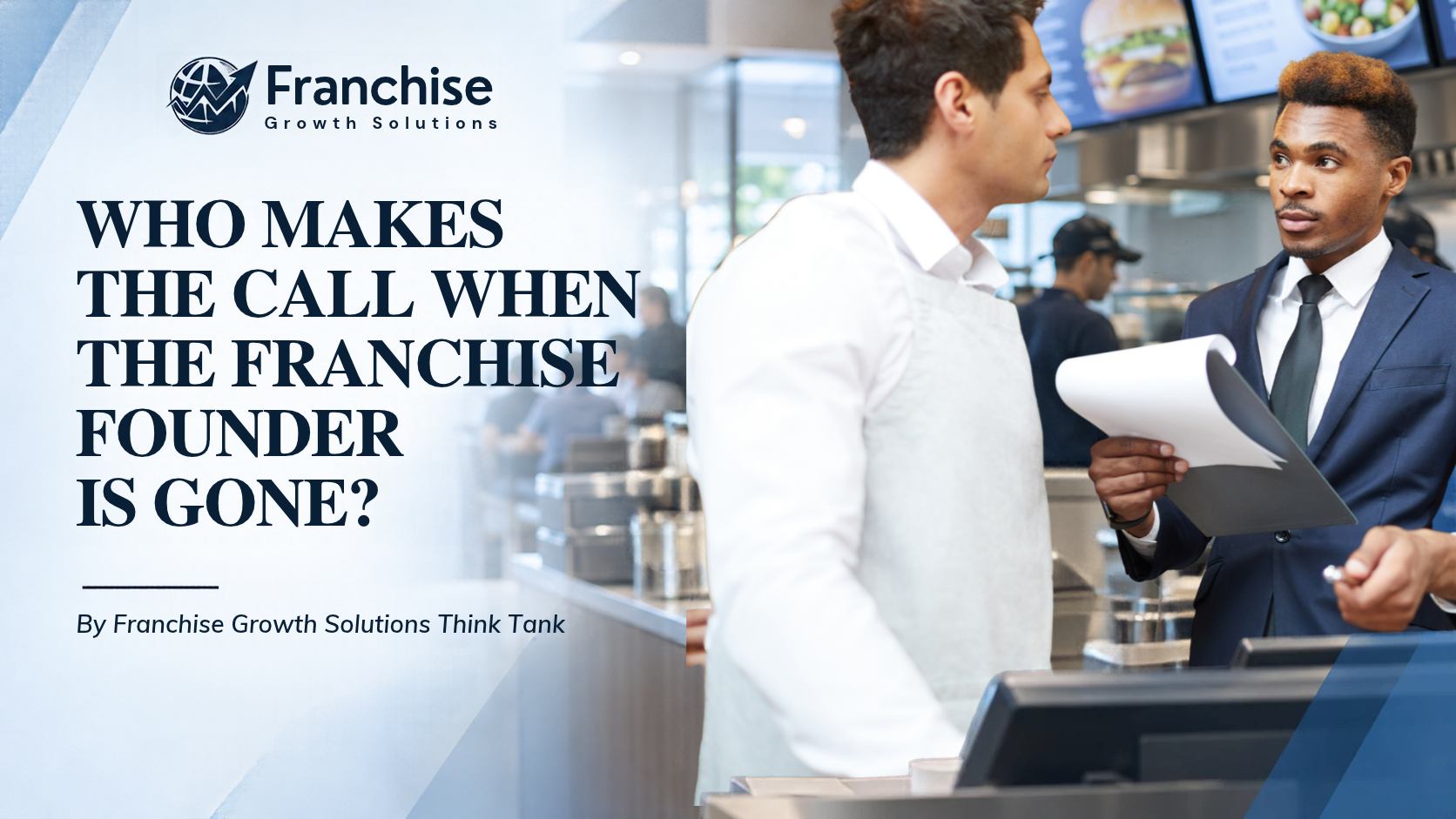
Photo Created By Canva
A founder who can keep a lunch rush moving has proved something about one restaurant. Before another owner invests in the concept, there is a harder question to answer. How much of what makes the restaurant work can somebody else learn, and how much still depends on the founder being there to notice what everyone else misses?
WHO MAKES THE DESICION WHEN THE FRANCHISE FOUNDER OR OWNER IS NOT AVAILABLE?
By Franchise Growth Solutions Think Tank
Suppose the phone rings at 11:15 on a Thursday. A good customer wants lunch for forty people by noon. At the original restaurant, the founder glances at the prep table, checks the orders already promised and offers to have everything ready at 12:30. She knows the customer has some flexibility. She also knows that the cook assembling those platters is the same person who will be feeding the guests already walking through the door. The order comes through, and by the time the lunch rush is over, everyone remembers the sale. Almost nobody remembers the half hour she negotiated to make it possible.
At a newly franchised location, an owner looking at the same order might see enough bread, meat and packaging to say yes. A kitchen can have spare ingredients and no spare minutes. The founder knew which employee would have to leave the counter to make the platters, and she knew enough about the customer to ask whether noon was a preference or a deadline. A training manual can tell a franchisee how many sandwiches go on a platter. Who teaches the owner what to ask before agreeing to make forty of them?
The Leadership First graphic attributes a useful observation to Simon Sinek. In his interview with Kelsey Humphreys, Sinek describes a leader as someone who becomes “responsible for the people who are responsible for the job.” He adds that a small business owner may still have to do the work personally while learning to lead others. Franchising adds a complication of its own. The person on the other end of the phone has bought a business. The franchisor can teach the method, explain the brand standards and help an owner solve a problem. The franchisee has customers to answer to and a payroll to meet after the call ends.
What the founder owes the next owner
Before awarding a franchise, a founder can learn a great deal by spending a lunch shift beside the manager of the original location and letting the manager run it. Afterward, compare notes on the decisions that mattered. Perhaps the manager accepted the noon deadline because a sign in the office says to accommodate catering requests whenever possible. To the founder, the exception seemed obvious, while to the manager, the sign read like an instruction. That difference is worth discovering while both people still work in the same building.
The fix might be as modest as adding one exercise to training. Give the incoming owner the actual order book from a busy day, the available prep time and a request from a valuable customer. Ask what pickup time they would offer and what they would say on the phone. An owner who proposes splitting the order into two deliveries may have found an option the founder overlooked. Talking through who will pay for the second trip, and whether the customer can use the food in two batches, teaches both people more than marking an answer right or wrong. It also gives the franchisor a chance to identify which promises every location must keep and where an owner has room to negotiate.
There is evidence that operating knowledge can stop at the boundary between owners. In a 1995 study, Eric Darr, Linda Argote and Dennis Epple examined weekly data from 36 pizza shops in southwestern Pennsylvania. All belonged to the same chain, and ten franchisees owned them. The researchers found evidence that production experience carried over between shops under common ownership. They found no comparable evidence of transfer between different owners. One chain in one region cannot tell us how well a modern franchise shares knowledge, and the study measured production costs rather than leadership quality. It does give a founder reason to ask how an improvement discovered by one franchisee will reach the next. A common menu and a shared sign did not accomplish that by themselves in the stores studied.
When field support earns its place
Consider a field consultant visiting a franchisee whose online reviews mention late pickups. One way to investigate would be to place an order, stand near the pickup counter and compare the time on the receipt with the time the kitchen first saw the ticket. If the brand’s ordering platform promises collection in fifteen minutes even when a large catering order is already in production, the franchisee has identified a problem that headquarters may be better placed to fix. Asking the owner to deliver a warmer apology does little for the next guest whose receipt carries a pickup time the kitchen cannot meet.
The consultant owes the franchisee the same candor when the evidence points back to the store. If the tickets arrive promptly and the promised times are workable, the local owner can spend a shift watching where orders wait. A bag might sit complete on the counter because nobody knows who calls the guest’s name. The owner can assign that responsibility and see whether the next lunch goes better. If the same delay shows up across several locations after a software change, headquarters has a different job. It can test the setting, correct it where warranted and tell the owners who first raised the issue what it found. Either way, the person being asked to act should have the authority to fix the cause.
In the United States, a prospective franchisee can investigate the quality of that relationship before signing. The Federal Trade Commission directs buyers to Item 11 of the Franchise Disclosure Document for information about training and assistance, and encourages them to speak with recent franchisees about the training they received. [3] One revealing follow-up for an owner is, “What was the first operating problem you took to headquarters after the opening team left, and what happened the next time it came up?” The answer tells a buyer something a count of classroom hours cannot convey.
The second location puts the owner to the test
A franchisee considering a second location faces much the same reckoning as the founder, with a financial question attached. Suppose the owner manages the first store on weekday mornings and regularly closes it on Sundays. Those hours have real value even when the owner takes draws and the shifts never appear as wages on the store’s income statement. Price the coverage the first store would actually need, including payroll costs, and account for any manager compensation already in the books. That adjustment gives the owner a better basis for deciding whether the first store can afford the management the second lease would require.
It is worth trying the arrangement while the owner can still change course. Let the general manager run the first location through a busy period, with clear authority over routine decisions and an agreed way to escalate serious ones. Then look at missed pickups, refunds, overtime and the calls that reached the owner. A profitable week that depended on a dozen quiet interventions deserves a closer look before it becomes the basis for an expansion budget. A call about an unfamiliar equipment failure, on the other hand, may show that the manager knew exactly when to ask for help. Counting calls without asking what prompted them could penalize the very judgment the owner wants to develop.
Back at the counter, the franchisee might offer the catering customer 12:15 and suggest two platters from the regular menu that the kitchen can assemble in time. The founder might never have considered that combination. A week later, another owner could use it to keep a sale that otherwise would have walked. That is a good reason for a founder to follow up after training with a question of her own: “What have you figured out at your location that we ought to teach at mine?”
For a conversation about preparing your business and your people for franchise expansion, contact Franchise Growth Solutions at info@frangrow.com.
© 2026 Franchise Growth Solutions LLC. All Rights Reserved, Worldwide.
Sources and URLs
- Leadership First, quotation graphic supplied for this article. The quoted passage in the text uses Simon Sinek’s own wording in his interview with Kelsey Humphreys for The Pursuit. Interview transcript.
- Eric D. Darr, Linda Argote and Dennis Epple, “The Acquisition, Transfer, and Depreciation of Knowledge in Service Organizations: Productivity in Franchises,” Management Science, November 1995. Findings reported in the authors’ abstract. https://doi.org/10.1287/mnsc.41.11.1750.
- Federal Trade Commission, A Consumer’s Guide to Buying a Franchise, discussion of Item 11 and franchisee interviews. https://www.ftc.gov/business-guidance/resources/consumers-guide-buying-franchise.
Copyright © Franchise Growth Solutions, LLC. All Rights Reserved Worldwide.
This publication is the intellectual property of Franchise Growth Solutions, LLC and is protected under United States and international copyright laws. No part of this publication may be reproduced, copied, distributed, transmitted, displayed, published, stored in a retrieval system, or translated into any language, in any form or by any means, including electronic, mechanical, photocopying, recording, scanning, or otherwise, without the prior written permission of the copyright owner, except for brief quotations used for review, commentary, criticism, or other uses permitted under applicable copyright law.
The information, opinions, observations, and recommendations contained in this publication are based upon the author’s professional experience, independent research, and analysis at the time of writing. They are provided for informational and educational purposes only and should not be construed as legal, financial, tax, accounting, investment, or other professional advice. Readers should consult qualified legal, financial, accounting, and other professional advisors before making business, investment, or franchise-related decisions.
References to franchisors, franchise systems, businesses, products, services, trademarks, or organizations are used solely for illustrative or educational purposes and do not constitute an endorsement, recommendation, or criticism unless expressly stated. All trademarks, service marks, and trade names remain the property of their respective owners.
While every reasonable effort has been made to ensure the accuracy of the information presented, the author makes no representations or warranties, express or implied, regarding the completeness, accuracy, or timeliness of the material and assumes no responsibility for errors, omissions, or changes that may occur after publication. Business conditions, laws, regulations, and market circumstances change over time, and readers are encouraged to conduct their own due diligence.
This publication reflects the opinions of the author and is intended to encourage thoughtful discussion regarding entrepreneurship, franchising, business ownership, and strategic growth. Any reliance upon the information contained herein is solely at the reader’s own risk.
For permissions, licensing inquiries, or reprint requests, please contact Franchise Growth Solutions at info@frangrow.com.
About Gary Occhiogrosso, Managing Parther
Gary Occhiogrosso is the Founder and Managing Partner of Franchise Growth Solutions, a full-service franchise advisory and development firm dedicated to helping emerging and established brands grow responsibly through strategic planning, franchise development, operational excellence, and professional franchise sales. During a career spanning nearly four decades, Gary has worked with hundreds of franchise organizations and has participated in the development and sale of more than 1,000 franchise locations across a broad range of industries.
Recognized as one of the franchise industry’s leading authorities, Gary has been named among the Top 100 Franchise Influencers and the Top 25 Fast Casual Executives. His work focuses on helping entrepreneurs, founders, and franchisors build scalable businesses through disciplined growth strategies, sound unit economics, operational consistency, and responsible franchising.
Gary is a frequent speaker, author, and publisher whose Executive Edition articles are designed to help entrepreneurs make informed business decisions based on experience, research, and practical application rather than industry hype or conventional wisdom.
Author’s Transparency Statement
This article was researched, developed, written, and professionally edited with the assistance of advanced artificial intelligence (AI) tools. Throughout the development of this manuscript, AI served as a research assistant, editorial collaborator, and, where appropriate, a ghostwriting partner to help organize ideas, review publicly available information, improve clarity, strengthen the narrative, and enhance the overall quality of the writing.
The ideas, opinions, analysis, conclusions, and professional insights expressed throughout this article are those of the author and reflect decades of real-world experience in franchising, business development, and entrepreneurship. Every section was reviewed, refined, edited, and approved by the author to ensure it accurately reflects his knowledge, experience, perspective, and voice.
Artificial intelligence was used to support the creative and editorial process, not to replace the author’s expertise, judgment, or accountability. The author accepts full responsibility for the accuracy, integrity, and final content of this publication.
The author believes that the transparent and ethical use of artificial intelligence as a research assistant, editor, and ghostwriting tool can improve the quality, efficiency, and accessibility of professional business writing while preserving the author’s original ideas, experience, and intellectual ownership.
Author’s Note
This article also reflects the author’s professional observations and practical experience accumulated over nearly four decades advising entrepreneurs, franchisors, franchisees, and investors throughout North America. Practical experience has been combined with publicly available research to provide balanced commentary intended for educational purposes.